jobmate vacuum cleaner

By signing up you agree to receive emails from DEWALT® with news, special offers, promotions and other messages tailored to your interests.DetailsShop-Vac 901-07 Reusable Filters and Mounting Ring FREE Shipping on orders over . DetailsShop-Vac 905-85 Foam Sleeve FREE Shipping on orders over . Product Dimensions20.3 x 20.3 x 3.8 cm Shop-Vac 906-61 Collector Filter Bags, 5 - 8 Gallons Shop-Vac 901-07 Reusable Filters and Mounting Ring Shop-Vac 919-64 High Effeciency Collector Filter Bags Fits FloorMaster and All-Around Plus POWERTEC 75003 High Efficiency 4 to 5-Gallon Filter Bags for Stanley 25-1230, 3-Pack 4 gallon collection bag. to see all 89 reviews What's behind our leaf blower Ratings? Handling and ease of use Noise at 50 ft. Leaf blower user reviews Leaf blower buying guide Gas blowers are still the fastest way to clear a yard full of leaves. More are also quieter, especially at the 50-foot distance used for most noise limits.

But our tests of more than 50 models show that lower prices and comparable performance for the best electric blowers make them a smart choice for most homeowners, especially if your leaf clearing is within 100 feet of a power outlet.
redstonetm ash vacuum cleanerSome corded-electric models we tested swept away leaves and loosened stubborn debris almost as well as our top gas blowers.
eureka forbes trendy steel vacuum cleaner snapdealAnd many gas models are far less noisy than older versions, while electrics are still quieter overall.
vax power 7 2200w bagless cylinder vacuum cleaner reviewThat's good news, particularly if your community is among the scores of municipalities with gas-blower regulations.
You'll also see cordless-electric blowers that combine the ease of a corded blower with the mobility of a gas model--though those we've tested have been pricey and offered relatively little run time before their batteries need recharging. Many areas prohibit unreasonable noise, including the whine of a blower, during certain hours--say, between 9 p.m. and 8 a.m. But some areas prohibit any blower louder than 70 decibels at 50 feet, and a few limit noise to 65 decibels (about as loud as a window air conditioner on high). Some gas blowers and all the electrics met the 70-decibel limit in our industry tests at 50 feet. And at 65 decibels or less in our latest tests, a few gas-powered blowers matched the quietest electrics we tested. Staying on good terms with your neighbors might be the best reason to choose a less-raucous blower, wherever you live. Cordless drills & tool kits Lawn mowers & tractorsHaving built my two bucket cyclone, I figured I might as well build a dust collector to use with it instead of that

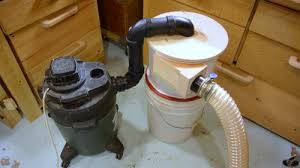
The trickiest part of building a dust collector For my previous dust collector, I used a 1/3 hp motor from a tile saw. That motor was barely adequate, so this time, I used a 2/3 hp motor from a really cheap "JobMate" table saw I bought for $20, just for the motor. From my previous experiments I knew that a paddle spinning in free air took about as much power to spin as an impeller with the same dimensions. So I experimented with how long a board I could spin with this motor I started with a longer board, but the motor was overloaded. shortened it until the current reading became acceptable for a 2/3 hp motor. After shortening it enough, I narrowed the board a bit and found I was able to add length to it again, this time by attaching two pieces of duct tape at the ends. I was able to spin a board as long as 34 cm. I then designed an impeller and housing using SketchUp. I designed the impeller at 35 cm, figuring if it overloaded the motor, I could always cut it down a

I also printed out some cutting templates for cutting the curved vanes of the impeller on my bandsaw. Cutting from the paper template eliminated any inconsistencies I might have introduced by drawing the arcs on the wood with a compass. But to lay the vanes out on the wood, I re-created the geometry with compasses on the plywood disk. This was easier than transferring the marks from the template to the wood. Here, I'm just checking the geometry by placing a few of the vanes on the impeller disk. I used various heavy objects to weigh down the vanes as I glued them. The plywood wasn't totally flat, so I wanted it pressed against a flat table top while gluing, and clamps would have been awkward for that. I used some scrap plywood to cut out the shape of the inside of the blower housing from the template. I then used that plywood shape to lay out pieces for the housing. I figured this time I'd build the housing up in alternating layers,

similar to what is often done in I just freehand marked what angles I needed, then cut the next piece's I gradually worked my way around the spiral housing. But it was difficult to make sure I had wood where I needed it. The clamps got in the way of the template, and I couldn't quite see how the lower layers lined up with the template. I kept alternating between working on the impeller and the housing as I waited for various glue-ups to dry. The impeller glue had dried by this time, so I could balance it. I balanced it by balancing it on a marble and seeing which way it had a tendencyI made a small block of wood, which I glued between the vanes to fix But at this time, I realized I made a major screw-up. My motor, looking at the shaft,But the impeller, as mounted on the shaft, needs to have the vanes curved away from rotation. So it absolutely needs toI opened up the motor, but it would have required major surgery on the internal wiring to reverse it.
So I had another idea. I made what was the back plate of the impeller into the front, by cutting a big (12 cm diameter) hole in it, and glued a disk with just a shaft plate against the "front", which would now become the back. By flipping the impeller around, the orientation of the vanes was reversed. I had to be really careful centring the new backer as I glued it on, or the impeller would have been thrown way off-balance. Luckily, after this change, the impeller only needed minor re-balancing. With the glue dried, I mounted it on the motor. It had a slight side-to-side wobble, but a paper shim on the arbour flange fixed that mostly. The motor consumed about 10 amperes with it spinning in free air. my previous experiment, I knew that it would consume about the same amount of power once mounted inside the housing. In the mean time, the glue for the housing had fully dried. the outline of the housing inside on the glue-up, then cut that out on
With the inside cut out, I made an offset marking tool out of a scrap of plywood and marked a line 15 mm from the inside edge of the blower.... ... then cut that out on the bandsaw. I then clamped the rotor housing on a piece of plywood. plywood template to mark where the motor's shaft needs to be and also traced the outline of the housing onto the plywood. Lucky for me, this motor is a flange mount motor. Otherwise, I would have had to make a small shelf for it. An 11 mm thick piece of plywood to go between the back of the blower and the motor put it at just the right distance back. Screwing on the housing edge. I should glue this on later, but for now I'm only screwing it so I can still make changes. Still need a front panel for the housing. I used my plywood template to work out where the hole should go, then cut that on the scroll saw. For the first tests, I only put it together with clamps. The blower blows surprisingly hard, and measuring the suction with my

manometer, it's equivalent to a 36 cm water column, or about 14". That's quite a lot, substantially more than my big dust collector, and twice as much as my cheap dust collector It's a lot of pressure for a dust collector type blower, but a vacuum cleaner or a ShopVac will typically develop about 150 cm of suction if airflow is blocked, about four times as much. The stream of air coming out of it is also quite powerful. float the head of a wooden mallet about 45 cm above the outlet. A question that has come up on the YouTube video again and again is "why not just use a furnace blower". The problem is, for a dust collector, especially one with a cyclone, you need a lot of pressure. A furnace blower will produce about 16 mm of pressure, which is about one tenth as much as my cheap dust collector, and one twentieth of this one. Another question that comes up: Can a 1750 RPM motor be used? I built a blower using a 1750