hoover constellation vacuum cleaner c1960
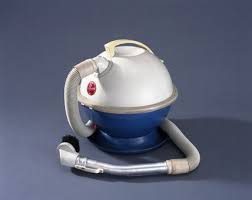
ConstellationsVacuum CleanersVacuumsBlack RingsCarpetsRingsBlackThe O'jaysHoover Constellation Floating Vacuum Here's a blast from the past: Hoover vacuums has reissued a modern day version of their 1954 floating canister carpet cleaner! Using exhaust air, the spherical little space-age inspired sputnik of cleaning utility literally floats on a cushion of air, and Hoover has brought the Constellation back with improved features like a HEPA filtration and twelve foot hose with telescoping handle. The reviews online from owners are positive, and I love the simple design that forgoes the current trend of overly accessorized upright vacuums. The only caveat is learning how to maneuver what is basically a small spherical hovercraft, but that seems sort of fun, and owners report that it's an easy adjustment. I guess I'll know myself in a few days when mine is delivered!This is the very first Hoover, the “ Model O.” In 1907, James Murray Spangler, a janitor in a Canton, Ohio department store, concluded that the carpet sweeper and broom he used were the source of his asthmatic cough so he began to experiment with a better type of sweeping apparartus.
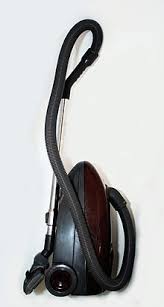
He salvaged an old fan motor and attached it to a soap box affixed to a broom handle. Using a pillow case as a dust collector on the contraption, Spangler invented a portable electric vacuum cleaner. He then improved his basic model -- the first to use both a cloth filter bag and cleaning attachments -- and received a patent in 1908. He formed the Electric Suction Sweeper Company. One of the first buyers was a cousin, whose husband, William H. Hoover, later became the president of the Hoover Company, with Spangler as superintendent. Sluggish sales were given a kick by Hoover�s 10 day, free home trial, and eventually there was a Hoover vacuum cleaner in nearly every home. The machine in this photo is from the Hoover Historical Center, not from my collection unfortunately. There are very few of these left, and they are quite rare and valuable. By the way, Murray Spangler’s “ suction sweeper” was the first [American] electric vacuum cleaner. Some accounts credit the Royal Company with this distinction, saying their cleaner was introduced in 1905.

The Royal Company did introduce a sweeper in 1905 but it was a cylindrical, upright, hand-pumped model, not an electric one.A brief history of the vacuum cleanerThe history of vacuum cleaners in the UK dates back to the early 1900s. Hubert Cecil Booth started the first vacuum cleaner company in the UK, known as the British Vacuum Cleaner Company. It wasn't long however before William Henry Hoover, who had already experienced success with his vacuum cleaners in America, made headway in the vacuum cleaners market in the UK and overtook Booth. Hoover's vacuum cleaners in the UK became such a success that ‘to hoover’ quickly became synonymous with vacuuming. Some of the earliest domestic vacuum cleaners in the UK incorporated simple reusable fabric bag designs whereby the vacuum cleaner simply collected dust in the bag. Once the bag was full, you could empty and reattach it to the vacuum cleaner. Unlike modern day vacuum cleaners in the UK, these vacuum cleaners didn't have advanced filtration, motorised brush bars or attachments to make vacuuming more effective.

For decades after their introduction, vacuum cleaners in the UK were a luxury item that only the upper class could afford. After World War II however they became common among the middle class.
nilfisk vacuum cleaners christchurchThis was especially true for vacuum cleaners in the UK because the popularity of carpets means sweeping is not an easy or effective means of carpet cleaning.
gmarket robot vacuum cleaner Although vacuum cleaners in the UK remained a luxury item for decades, throughout the 1930s and 1940s they were advancing at an incredible rate and by 1952 Hoover launched the Constellation, a pioneering canister vacuum cleaner that floats like a hovercraft.
eureka readyforce vacuum cleaner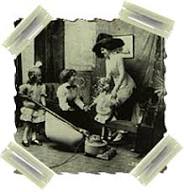
Hoover designed it so you could place the vacuum cleaner in the centre of the room and then work around it. After nearly 20 years of selling these vacuum cleaners in the UK, Hoover discontinued the Constellation in 1975. Advances to upright and cylinder vacuum cleaners in the UK continued, enabling vacuum cleaners to become more efficient and effective. By the 1980s, there was a vast range of bagged vacuum cleaners available in the UK and many of these have become collectors' items. The 1990s saw the introduction of the first bagless domestic vacuum cleaners in the UK. Despite many industry fears that consumers would not be prepared to pay the hefty price tag, bagless vacuum cleaners became a phenomenal success in the UK. These days bagless upright vacuum cleaners are the most popular choice in the UK. Upright vacuum cleaners are more popular in the UK than cylinder vacuum cleaners because the powerful rotating brush bars help to effectively lift hair from carpets.

That said, demand for cylinder vacuum cleaners in the UK is rising considerably as design innovations mean they can equal the performance of upright vacuum cleaners. The same can be said of cordless vacuum cleaners as advencments in battery technology has meant that the performance of cordless vacuums can now rival that of the corded cleaners. As for the future, vacuum cleaners in the UK are expected to become even more energy efficient. EU regluations that restricted the energy consumption of vaucum cleaners came into force in 2014 with further restrictions still to come into force. The move has sparked the launch of several pioneering vacuum cleaners in the UK, all of which feature low energy consumption but advanced designs and superior performance to ensure customers get better results from lower energy consumption.The requested URL /cgi-bin/index.cgi?brand=Hoover= was not found on this server.US industrial designer Henry Dreyfuss was born in Brooklyn, NY to a family in the theatrical materials supply business.

He completed studies as an apprentice to Norman Bel Geddes in 1924 and produced 250 stage sets for a number of theatres before 1928. He opened his own office in 1929 for stage and industrial design activities. In 1929, he won a "phone of the future" competition by Bell Laboratories and began work in 1930 in collaboration with Bell staff. The result of this association was the "300" tabletop telephone, with a receiver and transmitter in a "combined handset" resting in a horizontal cradle. Molded in black phenolic plastic, it was introduced in 1937 and produced until 1950. In 1933, he designed a new "flat-top" deluxe refrigerator introduced by General Electric, eliminating the previously exposed refrigeration unit by placing it beneath the cabinet. He also designed a new Toperator washing machine for Sears & Roebuck. Dreyfuss was featured in a 1934 article, "Both Fish and Fowl," in Fortune Magazine, written anonymously by George Nelson, which had a dramatic impact on the new field of Industrial Design.

An early client was Westclox, for whom he designed an alarm clock introduced in 1935, and later their famous Big Ben alarm clock in 1939. In 1934, he was engaged by the Hoover Co. and designed its 1936 Model 150 upright vacuum cleaner with the first plastic hood in Bakelite. His retainer fee was $25,000 per year. He designed a bottle for The American Thermos Bottle Co. that appeared in 1936. In 1936, his design of a Mercury locomotive debuted. It featured cutout holes in the "white-walled" driver wheels, lit by concealed spotlights at night. In 1938, with great fanfare, New York Central introduced 10 new streamliner steam engines and cars designed by Dreyfuss for its Twentieth Century Limited New-York-Chicago run. An upgraded version of his Mercury design, the new J 3 4-6-4 Hudson locomotives featured finned bullet-noses reminiscent of ancient warrior helmets. In 1938, Dreyfuss's John Deere Model A tractor was introduced. Dreyfuss started working with Deere in 1937. At the New York World's Fair in 1939, Dreyfuss designed the Democracity model in the Perisphere, representing an American city and its surrounding suburbs of the year 2039.

He also designed the AT&T pavilion, featuring Vodar, an early voice synthesizer. At the start of the war in 1941 Dreyfuss, along with Raymond Loewy and Walter Dorwin Teague were involved in the design of strategy rooms for the Joint Chiefs of Staff. Dreyfuss built four 13-foot rotating globes, one each for Roosevelt, Stalin, Churchill and the Joint Chiefs. Commercially, he designed the best-seller Skyliner fountain pen for Eversharp. The Society of Industrial Designers (SID) was established in 1944 by 15 practitioners, including Dreyfuss, who served as its first Vice-President. After the war in 1946, Henry hired William F. H. Purcell and Robert Hose, both of whom became partners in the firm. In 1949, the model 500 desk telephone was put into service by AT&T. Designed by Dreyfuss, it was the first to be offered in colors other than black beginning in 1954 and was still the most commonly used model in the US in 1995. Dreyfuss appeared on the cover of Forbes Magazine in 1951.
In 1953, Minneapolis Honeywell introduced a circular wall thermostat designed by Dreyfuss. He began consulting with the company in 1937. Dreyfuss published Designing for People in 1955, an autobiography that included the first publication of "Joe" and "Josephine" anthropological charts. He focused on design problems related to the human figure, working on problems from "the inside out", and believed that machines adapted to people would be the most efficient. The technical discipline called Human Factors was begun during the war and resulted in standards for the design of military equipment. Such data formed the basis of post-war design standards by Dreyfuss. By 1960, The Whitney Library of Design published Measure of Man, by Dreyfuss, an ergonomic data guide compiled from military records by the Dreyfuss office. It featured Joe and Josephine and popularized the idea of fitting products to human scale. The term "ergonomics" was coined in the early 1950s to describe the new profession focused on the study of human-equipment interaction.

Although Hoover discharged Dreyfuss in 1954, in 1955 they introduced their Model 82 Constellation vacuum cleaner designed by him, a spherical shape that glided on an air cushion of its own exhaust. In 1956, the wall-mounted telephone was re-introduced by Bell Telephone. Designed by Henry Dreyfuss Associates (HDA), it was intended as a companion to the desktop model "500." In 1958 Bell introduced his design for the first push-button telephone sets. And in 1959 Bell introduced the "Princess" phone, with hand/mouthpiece spanning the dial, and fitting compactly on the base. Its petite size was designed by HDA to appeal to teenage girls HDA designed a number of safety razors. The Pal stainless steel razor for American Safety Razor (1961), the Gem razor, for ASR Products Co. (1965), and the Flicker, a women's rotary manual safety razor, for the American Safety Razor Co. (1972). In 1963, the Polaroid Land Co. introduced its Model 100, the first to allow removal of photo to develop while shooting the next, designed by HDA.

They also designed the General Motors Futurama for the 1964 World's Fair in New York, the most popular exhibit. In 1965, The Industrial Design Society of America (IDSA) was formed by the merger of IDI, ASID and IDEA, becoming the single voice of industrial design in the US. Henry Dreyfuss was its first president. That same year, the "Trimline" telephone was introduced. Designed by Donald M. Genaro of HDA in collaboration with Western Electric staff, it combined receiver, transmitter and dial into a single element nested into a compact base Dreyfuss formally reorganized his office in 1967 as Henry Dreyfuss Associates, naming Donald M. Genaro, James M. Conner, and Niels Diffrient as associates. Henry retired to Pasadena, CA in 1969, but continued to serve the profession. Representing the American National Standards Institute (ANSI) in 1971, he chaired the first meeting of the International Organization of Standards Technical Committee (ISO/TC) in Berlin which set international standards for 145 signs and symbols.