deebot d76 robot vacuum cleaner

DEEBOT D77 The 3-D Vacuuming Robot by Ecovacs Robotics, Inc 13.1 x 13.1 x 3.9 inches #2,569,311 in Home and Kitchen (See Top 100 in Home and Kitchen) #1,215 in Home & Kitchen > Vacuums & Floor Care > Vacuums > Robotic Vacuums 44 star25%2 star25%1 star50%See all 4 customer reviewsTop Customer ReviewsCompletely unusableLOW EXPECTATIONS AND A FAT WALLET? THEN THE D77 MIGHT BE THE ROBOT FOR YOU!Pretty CoolHow go about with the warranty? I'm bought and using in Malaysia. /chat/viewtopic.php%3Ff%3D6%26t%3D14092%26start%3D20 on this server. Your technical support key is: 36b9-59bb-1756-6707The 2012 Consumer Electronics Show was not a big launching point for robotics companies this year. We saw Pleos, Paros, Paperos, and other familiar robots that didn't start with the letter "P" like Naos and Cubelets (not to mention Tosy's robotic boombox presented by Justin Bieber). Even iRobot decided not to put on an appearance: They were at CES taking meetings, but without a big booth presence like they've had in years past.

But we're always looking for what's coming next, and we did find one thing that got us excited. If you own a robotic vacuum cleaner, you probably know that one of the most annoying things about these devices is that when their dust bin is full, you have to clean your cleaning robot. The good news is that at CES we saw a couple of robot vacuums from Asia that come with docking stations capable of emptying the dust bins automatically. These are not the first robot vacuums to have the self-emptying dustbin feature. We've already seen one German vacuum that costs US $1,300 that can do this, and iRobot has had a patent on the books for a few years now, though the company hasn't made any announcements. So it's nice to see this feature, which we've been looking for since, well, forever, moving closer to becoming a mainstream option for consumers. The first one comes from a company that you've probably never heard of called Ecovacs. They're based out of China, and their Deebot D76 sports the following tagline: "It's a vacuum cleaner, it's a robot, and it's anything you want it to be!

Use Deebot D76 as anything you like!" Wow, that's pretty awesome, but let's just stick with using it as a vacuum for now, okay? Deebot moves around using "28 radar navigators," which we take to mean that it doesn't make active maps. It cleans, avoids obstacles, doesn't fall off of things, etc. but the interesting bit is the charging dock with an integrated vacuum system that both sucks the dirt out of the robot's vacuum bin and doubles as a portable vacuum cleaner.
electrolux nimble bagless cyclonic upright vacuum cleaner reviewsHere it is in operation:
kmart piranha vacuum cleaner The second vacuum comes from a company that you've definitely heard of: Samsung.
hoover superhero 1800w vacuum cleaner
The NaviBot-S includes an "auto dust emptying system," and when the robot senses that its dust bin is full, it heads back to the dock to get its dust sucked out, and as a plus it also gets its brushes cleaned to boot. Since the NaviBot makes an active map as it goes (using a camera pointed at the ceiling along with infrared sensors), it can then head back to right where it left off to finish cleaning the room. Nobody at the Samsung booth seemed to have much of a clue about what the deal was with the new dock, but we managed to snap some pics of a presentation playing on screens underneath robot itself, and we also dug up an Australian press release. Here are some pics of how the system works: And here's an overview video from CES that probably won't tell you too much more: Supposedly you'll be able to buy these vacuums in the United States within a year or two. But we should mention that we hear this type of thing nearly every single year at CES and nothing ever happens.

It does seem likely that Samsung's Navibot will show up in Australia, but contrary to what we heard from the Samsung reps, a U.S. launch isn't necessarily going to follow (one issue is iRobot's intimidating arsenal of robot vacuum patents). And as for the Deebot, well, that's even less certain. Self-emptying dust bins do seem like a logical (if incremental) next step in the evolution of robot vacuums, and if nothing else, it's nice to see a little bit of innovation in the consumer space at a show where the other big robot news involved a teenage pop star. [ Samsung Navibot ]Stop picking on robotic vacuums. If their brains were any bigger than a computer chip, maybe they'd be parking your car instead of cleaning your floors.The Deebot D77, the vacuuming robot from Ecovacs, is so dumb that it can't stop cleaning until its battery runs low. It cleans until it drops. But the obsessive-compulsive Deebot empties its dustbin automatically, which would leave the better-known Roomba, from iRobot, awe-struck.

It's also savvy enough to coerce resident humans to join the cleanup — the Deebot arrives with a canister vacuum that attaches to its docking station.Ecovacs christened the Deebot a "3D Vacuuming Robot" for that reason: The D77 handles two-dimensional flooring, leaving the above-floor third dimension, often known as curtains and cushions, to humans.In the robot world, that certifies the D77 as smarter than the "RoboCop" remake.After having the Deebot as a houseguest, and quasi domestic servant, the past several weeks, I wouldn't give up my brainless vacuum — a made-in-the-USA Metropolitan canister with HEPA filter. I would, however, welcome the D77 as chairman of the Routine Housecleaning Committee if I could stomach its $699.99 cost.In a smaller home or apartment, the Deebot might be the only vacuum necessary. The Deebot costs as much as iRobot's Roomba 880 but includes the hand-held vacuum that's also the dust repository.Ecovacs, makers of the window-cleaning Winbot robot and Famibot household assistant, designed D77's charging dock so the hand-held rests on top, like a space shuttle attached to NASA's Shuttle Carrier Aircraft.
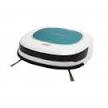
In that position, the D77 will offload its full dustbin into the hand-held.Once charged — it takes three hours for the 2500mAh battery — the D77 is on full alert. It has a control panel with LCD screen, four cleaning modes, a programmable feature for scheduling cleanings and a hand-held remote.I most often deployed the D77 in automatic cleaning mode so that it moved in a straight line until it struck something, redirecting its patch. The Deebot also has an intensive-cleaning mode, a spot-cleaning mode and an edge-cleaning setting. The D77 does not have boundary tracking, however, like the Roomba or Neato's robotic vacuums, that acts like an invisible fence. If you want it to clean a specific room, block the doorway or close the door. Then the D77 will clean the room until it's exhausted. pare that to the Neato Robotics vacuum, which scans a room and maps information on location of walls, furniture and other obstacles. It knows where it's going and knows when to quit.The Deebot, meanwhile, has no smart-mapping skills.

The D77's battery should last up to 100 minutes, about what the D77 spent on its first cleaning mission in a 10-by-12-foot room. My heart ached for the lil' Deebot, endlessly careening.It's not mentioned in the owners manual, but a sympathetic owner can mercy-kill the cleaning cycle, sending the Deebot to its docking station by pressing the "Home" and "Pause/Play" or "Mode" and "Home" buttons on the remote.Ultimately, the battery must be replaced long before it should.The D77 had trouble with throw rugs and any thicker-pile carpet. It also got stuck on a bedroom doorway lip, where old wood flooring met new, under a dresser and on a lamp cord.The hand-held is functional, good for basic cleaning, with accessories neatly stored in a plastic case. The D77, for a robot, is an effective cleaner: It tidied the messiest room in the house, where the cat's litter box and scratchpad reside.Smarts aside, a programmed Deebot can clean a house for weeks without human intervention because of its auto-empty feature.